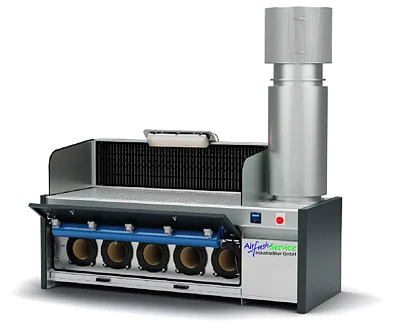
Extraction Tables for Industry
Clean air is far more than just a comfort factor in industry. It's a crucial component of occupational safety, process reliability, product quality, and sustainable production. Wherever grinding, welding, deburring, gluing, mixing, cutting, or working with dusty materials takes place, hazardous particles, fumes, vapors, or dust are generated. This is precisely where extraction tables come into play. They capture pollutants directly at the source and prevent contaminated air from spreading uncontrollably throughout the production hall.
Modern extraction tables for industry are available in various designs. Extraction tables with integrated filter systems and those without integrated filter systems, which are connected to a central extraction system, are particularly popular. Both options offer distinct advantages and are suitable for diverse industrial requirements. Choosing the right solution not only improves air quality but also increases workplace efficiency and reduces cleaning efforts, downtime, and strain on employees.
What is an extraction table?
An extraction table is an industrial workbench equipped with an extraction system. During the processing of workpieces, dust, chips, fumes, or other airborne substances are captured via the table surface, back panels, or sides. The contaminated air is then either cleaned by an integrated filter system or routed to an external filter and extraction system.
The major advantage of an extraction table lies in its source-based capture. Pollutants are not extracted only after they have already dispersed into the ambient air, but directly at their point of origin. This significantly reduces the spread of fine dust, grinding dust, welding fumes, or other emissions. This makes extraction tables an important component of modern industrial air purification.
Extraction Tables with Integrated Filter Systems
An extraction table with an integrated filter system is a compact and usually ready-to-use solution. The extraction system, filter unit, and often the fan are built directly into the table. The contaminated air is drawn in through the work surface or extraction openings, passed through various filter stages, and then either returned to the work area after cleaning or discharged in a controlled manner.
This option is particularly suitable for individual workstations, small production areas, workshops, laboratories, or businesses that do not wish to install a central extraction system. A mobile extraction table with a filter system can also be a practical solution for work locations that change frequently. Depending on the design, such systems can be used for a variety of applications, such as grinding, deburring, polishing, soldering, gluing, or light welding.
A significant advantage is the ease of integration into existing production environments. Since no extensive piping installation is required, extraction tables with integrated filter systems can often be put into operation quickly. They are also flexible in their positioning and can be used precisely where the air pollution originates.
Selecting the appropriate filter is crucial. Depending on the type of pollutant, coarse filters, fine dust filters, particle filters, activated carbon filters, or special filter combinations are used. While dust and particles are mechanically separated, gaseous substances or odors can be reduced under certain conditions using activated carbon filters. Regular maintenance is crucial for consistently reliable performance. Filters must be inspected, cleaned, or replaced to maintain consistent extraction efficiency.
Extraction Tables Without Integrated Filter Systems
Extraction tables without integrated filter systems are typically connected to a central extraction and filtration system. They have an extraction surface or capture elements, but no complete filter unit within the table itself. The contaminated air is transported via ductwork to an external filter system, cleaned there, and then either recirculated or vented to the outside.
This solution is particularly suitable for larger production areas, serial production, and facilities with multiple extraction points. If a hall contains numerous workstations with grinding, welding, or dust emissions, a central extraction system can be more economical and efficient than many individual, decentralized filter systems. Maintenance is concentrated on a central filter unit, and the entire air handling system can be precisely tailored to the operational requirements.
Another advantage lies in their high performance. Central systems can handle large air volumes and be equipped with high-performance filter technologies. This makes extraction tables without integrated filter systems suitable even for demanding industrial applications where high volumes of dust, metallic particles, smoke, or production-related emissions must be reliably captured.
However, this option requires careful planning. Piping, air volumes, flow velocities, filter technology, and energy consumption must be perfectly coordinated. Only if the system is correctly dimensioned will sufficient extraction be achieved at each extraction table. Therefore, professional planning of the extraction system is a crucial factor for success.
Air Pollution Control in Industry: Why Extraction Tables Are So Important
Air pollution control in industry has several objectives. It protects employees from harmful substances, keeps production areas clean, reduces deposits on machinery, and improves the quality of manufactured products. Fine dust, smoke, and fumes can irritate the respiratory system, contaminate surfaces, impair electrical components, or reduce visibility in the workplace. Controlled airflow is therefore essential in many production processes.
Extraction tables help to reduce pollutant concentrations in the production hall. They are particularly effective for tasks involving direct manual handling, as employees work very close to the source of emissions. When the contaminated air is captured directly via the table surface or a rear extraction system, exposure is significantly reduced. At the same time, the work area remains cleaner, which in turn improves ergonomics and efficiency.
Extraction tables also make economic sense. Less dust means less cleaning effort, reduced wear and tear on machinery, and fewer disruptions in the production process. Furthermore, good air quality can contribute to increased employee motivation and satisfaction. Investing in clean workplaces means investing in health, quality, and productivity.
Typical Applications of Extraction Tables
Extraction tables are used in many industries, including metalworking, mechanical engineering, plastics processing, woodworking, automotive manufacturing, electrical engineering, chemicals, pharmaceuticals, laboratories, and small-scale production facilities. Typical applications include grinding, deburring, welding, soldering, polishing, transferring, dispensing, cleaning, gluing, and processing dusty materials.
Grinding often produces fine particles that, without extraction, quickly enter the ambient air. Welding can release fumes and metal-containing particles. Handling powders or granules poses a risk of dust being stirred up. In all these cases, a suitable extraction table can directly capture emissions and remove them in a controlled manner.
Which solution is right for you?
Whether an extraction table with an integrated filter system or one without is the better choice depends on several factors. Crucial factors include the type of pollutants, the amount of emissions, the number of workstations, the spatial conditions, the desired level of mobility, and the existing infrastructure.
For individual workstations, flexible production areas, or smaller businesses, an extraction table with an integrated filter system is often the practical solution. It is compact, quick to set up, and does not require a central extraction system. For large industrial halls with multiple extraction points, an extraction table without a filter system, in combination with a central filter system, often offers advantages in terms of performance, maintenance, and energy efficiency.
The correct extraction technology is also important. Depending on the application, downward, rearward, side, or a combination of these extraction methods may be appropriate. The work surface, table size, material resistance, ease of cleaning, and system noise level should also be considered. Additional safety requirements must be observed when dealing with flammable, explosive, or particularly hazardous substances.
Conclusion: Extraction Tables as the Key to Clean Industrial Production
Extraction tables are a key component of modern air purification in industry. They capture dust, fumes, and particles directly at the workplace, thus making a significant contribution to health protection, cleanliness, and process reliability. Extraction tables with integrated filter systems offer flexibility, a compact design, and easy commissioning. Extraction tables without an integrated filter system are particularly suitable for centralized extraction solutions, larger production areas, and high-performance industrial applications.
Those who want to improve air quality in production should not view extraction tables as mere add-ons, but rather as a strategic investment in safe and efficient workplaces. The right extraction solution reduces emissions, protects employees, improves the production environment, and helps companies to operate cleanly, economically, and responsibly in the long term.