Air purification in the plastics industry: dust filters, ATEX filters and electrostatic filtration systems for safe processes
The plastics industry is characterized by diverse production processes, high material throughput, and demanding process chains. Whether conveying granules, grinding plastics, dosing powders, sawing components, processing composite materials, or reprocessing recycled materials: many work steps can generate potential airborne contaminants. These contaminants vary considerably depending on the process. They range from coarse plastic abrasion and fine dust to particles from additives, pigments, fillers, or ground material.
Effective extraction and filtration technology is therefore a crucial component of modern plastics processing. It supports clean production areas, protects machinery and equipment from unnecessary exposure, and contributes to safe working conditions. High-performance dust filters, robust bag filters, and, where dust risks are high, specially designed ATEX filters have proven particularly effective. Crucially, the right solution must always be precisely matched to the material, process, dust volume, and surrounding environment.
Potential Air Contaminants in the Plastics Industry
Air pollution in plastics processing is generated not only during obvious processing steps such as sawing, milling, or grinding. Particles can also be released into the air during conveying, mixing, dosing, shredding, bagging, filling, and emptying. Targeted dust collection is particularly important when working with powdered raw materials, additives, or recycled plastics.
Typical potential air contaminants in the plastics industry include plastic dust, fine dust, granule abrasion, fibers from reinforced plastics, filler particles, pigment dust, carbon black particles, additive powders, and dust from ground material. Fine particles can also be generated during the processing of glass fiber reinforced plastics or engineering plastics, which then disperse in the ambient air and settle on machines, factory floors, or workpieces.
Recycling plants face additional challenges. Varying material qualities, contaminated feedstocks, label remnants, foreign particles, or mixed plastics can lead to fluctuating dust levels. Shredding, grinding, and pneumatically transporting plastic waste often generates particles that must be reliably separated. Therefore, choosing the right filter solution depends not only on the amount of dust but also on its properties: Is it fine, coarse, sticky, electrostatically charged, abrasive, or potentially flammable?
Why professional dust filters are important in plastics processing
A dust filter ensures that dust-laden air streams are cleaned and particles are separated in a controlled manner. This is particularly important in the plastics industry because dust deposits can be problematic in many areas. They increase cleaning efforts, can contaminate sensors and machine components, and may even affect the quality of manufactured products.
Dust filters are used in various applications, such as mills, cutting mills, dosing stations, mixers, silos, big bag emptying systems, bagging systems, conveyor lines, and processing machines. Depending on the production setup, a central filter system can capture multiple emission sources, or a decentralized solution can be installed directly on a single machine.
Several factors come into play when selecting a dust filter. These include the required airflow, particle size, dust concentration, operating time, airflow temperature, and the desired dust discharge method. Ease of maintenance is also an important consideration. Filter systems in the plastics industry often need to operate reliably in multi-shift operation. Easily accessible filter elements, stable differential pressure values, and a well-designed cleaning process help to avoid downtime.
Bag Filters for High Dust Volumes and Robust Industrial Processes
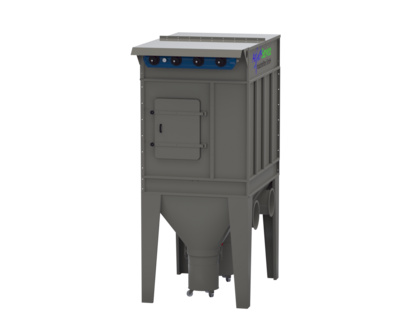
A bag filter is particularly advantageous when large quantities of dust or continuous airflows need to be cleaned. Unlike compact filter elements, bag filters utilize elongated filter bags, providing a large filter surface area and ensuring reliable performance even in demanding applications.
In the plastics industry, bag filters are suitable for applications such as pneumatic conveying systems, silo filling, mixing processes, granulate handling, plastics recycling, shredding plants, and production areas with high dust levels. The dust-laden airflow is directed into the filter housing, where the particles adhere to the filter bags, and the cleaned air is then passed on. Automatic cleaning regularly removes accumulated dust from the bags. The collected dust falls into a collection chamber, container, or discharge chute and can be disposed of in a controlled manner or, depending on the material and process, further treated.
A major advantage of bag filters lies in their adaptability. They can be designed for various air volumes, dust types, and system layouts. The choice of filter material can also be adapted to the application. Suitable filter media can be used for fine plastic dusts, antistatic requirements, abrasive particles, or specific temperature ranges. This makes the bag filter a robust solution for production environments where dust is generated continuously.
ATEX Filters for Combustible Plastic Dusts
Many plastics and plastic dusts can be flammable under certain conditions. If fine particles are mixed with air in sufficient concentration and an ignition source is present, an explosive dust-air mixture can form. Therefore, the plastics industry must carefully assess whether an ATEX filter is required for individual processes.
ATEX filters are used for applications where explosive atmospheres cannot be reliably prevented. This applies, for example, to certain grinding processes, conveyor systems, mixers, silos, powder dosing systems, or recycling plants. Additives, pigments, fillers, or dust-like auxiliary materials can also be relevant if they possess flammable properties or promote electrostatic charging.
An ATEX-compliant filter solution considers more than just the filter itself. The entire system, including the collection system, piping, filter unit, fan, dust extraction, control system, and safety components, is crucial. Depending on the hazard assessment, measures such as pressure relief, flameless pressure relief, explosion isolation, grounding, antistatic filter media, or spark-reducing pre-separation may be required. The most suitable solution depends on the dust properties, the system design, and the operating conditions.
Especially in the plastics industry, individual assessment is essential because materials can react very differently. Polyethylene, polypropylene, PVC, engineering plastics, fiber composites, and recycled mixtures each have their own specific requirements for extraction, filter media, and safety concept. Therefore, an ATEX filter should never be selected generically, but always based on the specific application.
Filter technology for processing, recycling, and material handling
The applications for dust filters, bag filters, and ATEX filters in the plastics industry are wide-ranging. Dust clouds can be generated during raw material intake when filling silos or big bags. When dosing powders and additives, precise extraction is often necessary to minimize material release into the environment. In production, extruders, cutting mills, separation systems, mixing systems, or processing machines can be connected to a filter system.
Air purification is particularly challenging in plastics recycling. Shredding rejects, films, molded parts, or packaging materials generates dust and light particles that must be reliably captured. Furthermore, material types and levels of contamination change frequently. A flexible and robust filter system helps achieve reliable separation even under fluctuating conditions.
Filter technology may also be necessary in the further processing of finished plastic parts. Milling, drilling, sawing, grinding, or deburring produce chips and fine dust. These should be captured as close as possible to their source to prevent them from spreading throughout the work area. Effective extraction reduces deposits and facilitates the cleaning of machines, tools, and production areas.
Clean air contributes to stable production conditions.
In the plastics industry, a suitable filtration system offers more than just dust removal. It supports stable process conditions and can help reduce downtime, cleaning efforts, and material carryover. A clean environment is a clear advantage, especially for sensitive production processes, automated lines, or high-quality products.
Dust deposits can accumulate on conveyor systems, control components, sensors, molds, tools, or packaging areas. Early particle capture significantly reduces the risk of such deposits. At the same time, workplaces become more pleasant because dust-laden air is not unnecessarily circulating in the hall.
Correct sizing is crucial for economical operation. A system that is too small will not reliably capture airborne contaminants, while one that is too large will result in unnecessary energy costs. Therefore, air volume, filter area, piping, cleaning, discharge, and safety requirements should be carefully coordinated. Thorough planning is particularly important for bag filters and ATEX filters, as technical performance, operational reliability, and maintenance requirements are closely intertwined.
Customized Filter Solutions for the Plastics Industry
The plastics industry requires filter technology tailored to its specific processes. Standard solutions are often insufficient because material properties, dust behavior, and production conditions vary considerably. A company that handles plastic granules has different requirements than a recycler, a compounder, a manufacturer of technical plastic parts, or a company with extensive powder dosing.
Therefore, a reliable solution begins with a precise analysis of potential airborne contaminants. Based on this analysis, suitable dust filters, high-performance bag filters, and, if required, ATEX-compliant filters can be selected. The result is a customized system that effectively separates particles, keeps production areas cleaner, and supports operations in the long term.
Investing in professional filter technology lays the foundation for controlled airflow, reliable dust separation, and safe processes in plastics processing. Especially in an industry with diverse materials, high throughput, and increasing quality demands, well-designed air purification is a crucial component of modern, clean, and efficient production.