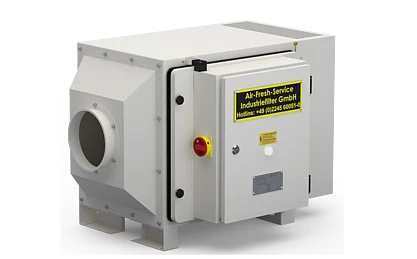
Oil mist filter F-V
light to very heavy emissions
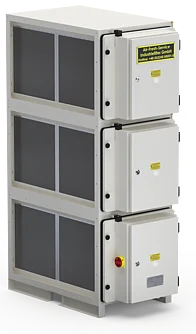
Oil mist filter F
Filter systems for plant engineering
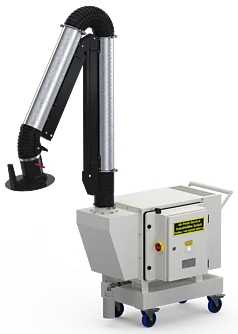
Oil mist filter F-V MOBILE
mobile filters with detection system
Electrostatic oil mist separators – modern oil mist filters for industry and manufacturing
In the metalworking industry, CNC manufacturing processes such as turning, milling, grinding, and forming frequently generate oil mist, emulsion mist, smoke particles, and fine aerosols. These particles not only pollute the ambient air but can also damage machinery, electronic components, factory walls, tools, and, most importantly, the health of employees. This is precisely where electrostatic oil mist separators and high-performance oil mist filters come into play. They ensure clean air in the workplace, reduce deposits in the production environment, and help companies make their processes cleaner, safer, and more efficient.
A modern oil mist filter is much more than a simple air purifier. Multi-stage electrostatic air filters, in particular, offer high separation efficiency with low energy consumption. Electrostatic separation removes even the finest particles from the contaminated process air. This makes electrostatic oil mist separators an efficient solution for production facilities that prioritize occupational safety, machine availability, process reliability, and energy efficiency.
Why Oil Mist Separation Is So Important in Production
Oil and emulsion mists are generated wherever cooling lubricants are used. During machining, these fluids are finely atomized by high speeds, pressure, temperature, and mechanical action. Without proper extraction, the aerosols spread throughout the production hall. This results in unpleasant odors, slippery floors, contaminated machine surfaces, and increased air pollution.
Professional oil mist filters capture the contaminated air directly at the source or in the machine room. This prevents oil mist from spreading uncontrollably throughout the hall. Electrostatic systems are particularly attractive because they not only separate particles but, with proper design, can also be operated economically over the long term. While purely mechanical filter elements must be replaced regularly, electrostatic filter cells can be cleaned and reused. This reduces consumables, maintenance, and operating costs.
Electrostatic Oil Mist Separators: Function and Advantages
In electrostatic oil mist separators, the contaminated air is first drawn in and passed through pre-filters. Larger particles and droplets are separated in this first stage. The finer aerosols then enter the electrostatic filter zone. There, the particles are electrically charged and collected on collector plates. Depending on the application, the cleaned air can then be recirculated back into the building or exhausted to the outside.
The major advantage of this technology lies in the combination of high separation efficiency and low pressure losses. Low pressure losses mean that the fan requires less energy to move the air through the filter system. As a result, electrostatic oil mist separators make a significant contribution to energy efficiency in production. The use of modern, efficient oil mist filters can quickly become noticeable, especially in companies with many machine tools.
F-V Oil Mist Filters for Stationary Applications
The F-V series represents a high-performance solution in the field of electrostatic oil mist separation. An F-V oil mist filter is particularly suitable for stationary machines, machining centers, and production lines where oil mist, emulsion mist, or smoke must be continuously extracted. Thanks to its robust construction, multi-stage filter technology, and application-specific design, an F-V system can contribute to long-term improvements in air quality.
Reliable extraction is crucial, especially for CNC machines, grinding machines, and machine tools. A properly sized F-V oil mist separator protects not only employees but also the machine itself. Less oil mist means fewer deposits on sensors, electronics, guides, and machine housings. This can reduce cleaning efforts, minimize downtime, and make the production environment noticeably cleaner.
F-V Mobile Oil Mist Separators for Flexible Use
Not every application requires a permanently installed extraction system. For changing workstations, individual machines, temporary processing operations, or service calls, F-V MOBIL oil mist separators offer a particularly flexible solution. Mobile oil mist filters can be deployed wherever extraction is needed. They are ideal for workshops, test fields, small-batch production, or production areas where machines are not permanently connected to a central extraction system.
An F-V MOBIL oil mist separator can be quickly positioned and adapted to the specific application. This provides companies with maximum flexibility without compromising on professional filtration technology. Mobile systems can also be designed as multi-stage electrostatic filtration systems, thus combining high separation efficiency with efficient operation. For companies that want to gradually improve their air quality, a mobile solution is often a sensible starting point.
Multi-stage electrostatic air filters for high separation efficiency
Multi-stage electrostatic air filters are particularly effective because they combine different filter principles. A typical filter chain can consist of pre-separation, electrostatic main separation, and optional post-filter stages. This allows for the reliable capture of both coarse droplets and the finest aerosols and smoke particles. This multi-stage design is especially important in demanding applications. High-speed milling, grinding, or machining with oil-based cooling lubricants can generate very fine particles. The finer the particles, the more important high-performance filter technology becomes. Electrostatic oil mist separators offer a clear advantage here because they can efficiently separate even small particles without unnecessarily increasing energy consumption due to heavily clogged filter media.
Energy efficiency through frequency-controlled technology
Energy efficiency is a key factor in modern oil mist filters. Manufacturing companies are increasingly focused on electricity consumption, CO₂ reduction, and operating costs. Therefore, oil mist separators are particularly attractive when they operate with frequency control. A frequency-controlled fan adjusts its output to the actual demand. The system therefore doesn't run continuously at full power, but only as much as the specific application requires.
This saves energy, reduces noise emissions, and can extend the service life of the components. Combined with electrostatic filtration technology, low pressure losses, and intelligent control, this results in a particularly economical overall system. For companies that want to make their production more sustainable, frequency-controlled electrostatic oil mist separators are therefore a future-proof investment.
BAFA Funding for Energy-Efficient Extraction and Filtration Technology
Anyone investing in energy-efficient oil mist filters, frequency-controlled fans, or modern extraction technology should also explore BAFA funding options. BAFA describes its federal funding program for energy and resource efficiency in business as support for measures that increase the energy and resource efficiency of industrial and commercial processes. For certain measures, proof of energy or greenhouse gas savings may be required.
In Module 1, the BAFA (Federal Office for Economic Affairs and Export Control) lists, among other things, highly efficient electric motors, pumps, fans, and compressed air generators as eligible cross-cutting technologies, provided they replace existing systems or components. For energy-related optimizations of systems and processes, there are also more technology-neutral approaches where a savings concept and verifiable savings may be relevant.
Important: Potential BAFA funding should always be checked before the project starts. Eligibility, minimum technical requirements, and application procedures depend on the specific project, the existing system, the planned technology, and current funding conditions. Therefore, it is advisable to clarify during the planning phase whether an F-V oil mist separator, an F-V MOBILE oil mist separator, or a frequency-controlled extraction solution can be eligible for funding as part of an efficiency measure.
Clean air, lower costs, and sustainable production
Electrostatic oil mist separators offer companies many advantages: They improve air quality, protect employees, reduce contamination, and contribute to stable production conditions. At the same time, modern oil mist filters can reduce ongoing operating costs through energy-efficient technology, frequency-controlled fans, and reusable filter cells.
Whether as a stationary F-V oil mist separator for machining centers or as an F-V MOBILE oil mist separator for flexible applications: The right filter solution ensures that oil mist is removed where it originates. Multi-stage electrostatic air filters offer particularly high performance and are an economical and sustainable choice for many industrial applications.
Investing in modern oil mist separation systems today means investing not only in clean air, but also in workplace safety, machine availability, energy efficiency, and future-proofing. Therefore, electrostatic oil mist separators and high-quality oil mist filters are essential components for modern production facilities that want to operate efficiently, cleanly, and responsibly.