Filter systems for the building materials industry: Clean air, better energy efficiency and greater environmental responsibility
The building materials industry processes large quantities of mineral raw materials. Cement, lime, gypsum, sand, gravel, natural stone, clay, aggregates, mortar, drywall materials, plasters, screeds, and specialty mixtures are crushed, ground, screened, dried, conveyed, dosed, mixed, filled, or loaded. These processes often generate potential air pollution that must be reliably controlled. Mineral dust, in particular, can spread rapidly in production areas, at transfer points, on machinery, in silos, or into the ambient air.
Modern filter systems therefore play a crucial role in the building materials industry. They capture dust-laden air streams, separate particles, and support clean, safe, and economical plant operation. At the same time, environmental protection and energy efficiency are becoming increasingly important. Companies want to reduce emissions, use resources more consciously, control operating costs, and future-proof their production facilities. Sophisticated filter technology combines these requirements into a comprehensive solution.
Potential Air Pollution in the Construction Materials Industry
The type of air pollution in the construction materials industry depends heavily on the raw material and the specific processing step. Mineral dusts are particularly common. These include cement dust, lime dust, gypsum dust, quartz dust, sand dust, clay dust, stone flour, filler particles, fly ash, aggregate abrasion, and dust from recycled building materials. Pigments, additives, fibers, and powdered binders can also play a role in certain production areas.
Emissions frequently occur where material is moved or mechanically processed. Typical dust sources include crushers, mills, screening plants, dryers, conveyor belts, bucket elevators, transfer points, silos, mixing plants, big bag stations, bagging stations, bagging systems, loading facilities, and mobile material handling points. Dust pollution can also occur during plant cleaning, emptying of residual materials, or maintenance work.
A particular challenge in the construction materials industry is the often high volume of dust. Many processes run continuously with large material flows. As a result, filter systems must not only retain fine particles but also withstand demanding operating conditions. Abrasive dusts, high dust loads, fluctuating humidity, temperature variations, and long operating times place high demands on filter media, housings, discharge systems, and fans.
Why air purification is so important in building materials production
Dust in the building materials industry is more than just visible pollution. Fine particles can contaminate work areas, impair visibility, soil machinery, and significantly increase cleaning efforts. Deposits on sensors, drives, bearings, or control components can also impair plant availability. If dust escapes into the environment, it also affects the surrounding area and the environment.
For many companies, effective air purification is therefore a crucial part of their operational management. It helps keep production areas cleaner, reduce material losses, and ensure controlled emissions. Especially in dust-intensive processes, it is advantageous not to filter only at the end of the exhaust air path, but to capture dust close to its source. This prevents particles from spreading over a large area.
Product quality can also benefit from good filter technology. In mixing plants, filling areas, or during the production of fine building material mixtures, uncontrolled dust deposits can be problematic. Clean plant environments support more consistent processes and facilitate maintenance.
Filter systems for mineral dusts and high material throughputs
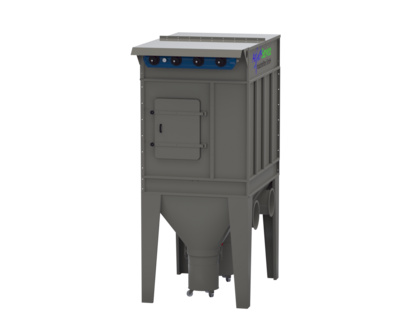
Filter systems in the building materials industry often need to be particularly robust. They are used in dusty production environments and are frequently part of large production lines. Depending on the application, they can be designed as central dust collection systems, machine filters, silo filters, point extraction systems, or process filters.
Dry-operating filter systems are frequently used for dry mineral dusts. They separate particles from the airflow and collect the separated dust in containers, hoppers, airlocks, or conveyor systems. For high dust loads, filter systems are required that enable reliable cleaning. The filter elements are regularly cleaned of adhering dust, ensuring a stable airflow and preventing unnecessary pressure drop.
Selecting the appropriate filter medium is crucial. Fine dusts require high separation efficiency, abrasive particles need resistant materials, and moist dusts may necessitate special surfaces or specific operating conditions. Airflow within the filter housing also plays an important role. Uniform airflow protects the filter elements from uneven stress and promotes stable operation.
Compact filter systems are often used for silos and containers, cleaning the displaced air generated during filling. In contrast, crushing, grinding, and screening processes require robust systems with high dust holding capacity. In mixing and bagging plants, it is particularly important to capture dust directly at open transfer points, dosing points, or filling heads.
Protecting the environment through controlled emission reduction
In the building materials industry, environmental protection is closely linked to air pollution control. Dust emissions can settle on company premises, traffic routes, adjacent areas, and surrounding regions. The better emissions are captured and filtered, the lower the environmental impact. Modern filter systems thus make a direct contribution to reducing visible and invisible particle emissions.
The responsible use of raw materials also plays a role. Captured dust is often not simply waste, but can be reintroduced into the production cycle, depending on the process and material. For example, filter dust from certain mixing or grinding processes can be reused if its quality and composition allow. This reduces material losses and enables more efficient resource utilization.
In the building materials industry, environmental responsibility therefore extends beyond mere exhaust air purification. The focus is on closed material flows, reduced dust emissions, clean transport routes, lower cleaning costs, and better control of emission sources. A well-planned filtration system supports these goals and helps companies make their production more sustainable and transparent.
Energy efficiency as a key planning factor
In addition to separation efficiency, the energy efficiency of filtration systems is becoming increasingly important. Extraction systems require energy, primarily for fans, compressed air cleaning, controls, and material discharge. Since many systems in the building materials industry operate for extended periods, even small efficiency improvements can have a significant impact on operating costs.
An energy-efficient filtration system begins with proper sizing. Excessive air volumes cause unnecessary energy consumption, while insufficient air volumes result in inadequate dust capture. A balanced relationship between capture velocity, piping design, filter area, and fan performance is therefore crucial.
Pressure loss within the system also affects energy efficiency. Long piping, unfavorable bends, clogged filter elements, or incorrectly designed components increase resistance and thus energy consumption. Modern filter systems therefore rely on flow-optimized designs, suitable filter media, and automatic cleaning. Demand-based control can further help to adapt the performance to the actual process. If certain areas of the system are not in continuous operation, the extraction capacity does not need to run at maximum level constantly.
Another approach is continuous monitoring. Differential pressure measurement, flow rate control, and status messages indicate whether the filter system is operating efficiently or whether maintenance is required. This allows unnecessary energy losses to be identified early on.
Capture at crushers, mixers, silos, and loading points
In the building materials industry, proper dust collection is the first step toward a successful filtration solution. Dust should be captured as close as possible to where it is released. For crushers and mills, closed transfer systems and targeted extraction points are crucial. For screening plants and conveyor belts, transfer points, discharge areas, and material transitions must be taken into account. Emissions from silos occur primarily during filling, while dust can be generated at the filling head or during bag changes in bagging systems.
A suitable collection system is required for each dust source. This can include hoods, enclosures, extraction nozzles, flexible connections, closed transfer boxes, or integrated machine extraction systems. The design must be robust enough to withstand dust, vibrations, and material movement. At the same time, it should remain easily accessible to allow for cleaning and maintenance without significant effort.
Careful retrofitting is particularly important for existing plants. Space is often limited, production processes are well-established, and machines are difficult to access. In these cases, filtration systems must be designed to improve existing production without unnecessarily disrupting operations.
Maintenance, Uptime, and Operational Reliability
A filter system in the building materials industry must function reliably over the long term. Downtime can quickly lead to high costs, especially when multiple production areas are connected to a central dust extraction system. Therefore, ease of maintenance and operational reliability are crucial criteria.
Easily accessible inspection openings, robust discharge systems, wear-resistant components, and appropriate filter cleaning facilitate operation. For highly abrasive dusts, vulnerable components should be specially protected or designed to be replaceable. The dust discharge must also be appropriate for the amount of material. If the collected dust is not reliably removed, blockages, pressure increases, or operational malfunctions can occur.
Regular inspection of the filter elements, fans, piping, and discharge devices helps to identify problems early. Modern control systems can monitor operating parameters and issue warnings before performance deteriorates significantly. This transforms the filter system into a controllable part of the production process.
Customized Filter Systems for the Building Materials Industry
The building materials industry encompasses many different production areas. A cement plant has different requirements than a gypsum board manufacturer, a lime works, a concrete block producer, a dry mortar plant, a natural stone processing facility, or a mineral building material recycling plant. Therefore, filter systems should always be tailored to the specific application.
The process begins with an analysis of potential air pollutants. What materials are processed? Where is dust generated? What is the dust load? Are the particles fine, coarse, abrasive, moist, or subject to temperature fluctuations? What environmental requirements apply? What energy targets need to be met? What maintenance intervals are realistic for operation?
Based on this information, a filter concept is developed that reduces dust emissions, protects equipment, minimizes environmental impact, and improves energy efficiency. A professional solution considers not only the filter itself but the entire system, including collection, piping, fans, cleaning, discharge, controls, and maintenance.
For companies in the building materials industry, modern filter technology is therefore a crucial component for clean production and sustainable plant operation. It helps to control potential air pollution, reduce the burden on the environment, use energy efficiently, and make production processes more reliable in the long term.