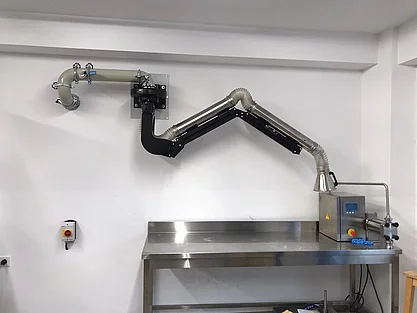
Extraction arms and air pollution control in industry
In industrial production environments, dust, fumes, vapors, aerosols, and gaseous pollutants are generated daily. Whether welding, grinding, soldering, gluing, mixing, filling, or processing metals, plastics, and chemicals, the quality of the indoor air plays a crucial role in health, occupational safety, product quality, and the efficiency of operational processes. Extraction arms are a particularly effective solution for industrial air purification. They enable the flexible and precise capture of pollutants directly at their source.
Unlike simple hall ventilation, extraction arms utilize point extraction. This means that contaminated air is not first distributed throughout the entire space and then diluted, but rather captured at the source. This significantly reduces workplace exposure. For companies, this is an important step toward creating safe working conditions, keeping equipment clean, and making processes more economical.
What are extraction arms?
Extraction arms are movable capture elements that are connected to extraction systems, filter systems, or central ventilation systems. Depending on the model, they consist of joints, pipes, hoses, hoods, and a sturdy support structure. Their flexible design allows them to be positioned directly at the work area. The operator positions the extraction arm so that smoke, dust, or fumes are captured as close as possible to their source.
Extraction arms are particularly common in metalworking, mechanical engineering, welding shops, laboratories, workshops, chemical plants, plastics processing, food production, and surface treatment. Depending on the application, they can be designed for dry dust, welding fumes, soldering fumes, oil mist, solvent vapors, or other airborne substances.
Why is air pollution control so important in industry?
Industrial air pollution control is far more than a technical side issue. It is a central component of modern production planning. Polluted air can negatively impact employee health, contaminate machinery, interfere with sensors, pollute surfaces, and negatively affect product quality. Especially fine particles, fumes, or chemical vapors can quickly spread through the ambient air if they are not captured in time.
A professional air purification concept helps to make workplaces safer and more pleasant. At the same time, it supports companies in complying with legal requirements, internal quality standards, and occupational safety regulations. Clean air in production halls also has a positive effect on employee motivation, concentration, and performance. Those who work in a consistently clean environment are exposed to fewer toxins and can concentrate better on precise work processes.
Extraction arms as a key component of point extraction
The major advantage of extraction arms lies in their proximity to the source of pollutants. The closer the extraction point is to the source, the more efficiently the entire extraction system operates. If an extraction arm is positioned correctly, a comparatively small volume of air can be sufficient to reliably capture pollutants. This saves energy, reduces operating costs, and relieves the burden on filter systems.
General room ventilation has to move large volumes of air to achieve similar effects. Point extraction with extraction arms is therefore often the more economical and effective solution. Extraction arms offer significant practical benefits, especially in environments with changing workstations, manual tasks, or flexible production cells. They can be adjusted, swiveled, extended, and positioned precisely where needed.
Applications of extraction arms in industry
In welding technology, extraction arms are used to capture welding fumes, metal oxides, and fine particles. During grinding and polishing, dust and abrasion are captured before they settle on machines, workpieces, or work surfaces. In the chemical industry, extraction arms can help to remove vapors and gases in a controlled manner. They are also a proven solution for reducing soldering fumes and flux vapors during soldering operations in electronics manufacturing.
Air purification also plays a crucial role in the food and pharmaceutical industries. Here, it's not just about protecting employees, but also about hygiene, product safety, and controlled production conditions. Extraction arms can be used, for example, when weighing, mixing, or transferring dusty substances. In workshops and training facilities, they improve air quality at individual workstations and enable flexible use of different work areas.
The right choice: What matters when choosing extraction arms?
For extraction arms to be fully effective, they must be suitable for the specific application.
Crucial factors include the type and quantity of pollutants produced, the required reach, the diameter of the extraction arm, the design of the capture hood, the mobility, temperature resistance, and chemical resistance of the materials. The air volume and negative pressure of the connected system must also be carefully coordinated. Robust extraction arms with flow-optimized hoods are frequently used for welding fumes. Special materials may be required for aggressive vapors. Appropriate safety concepts must be considered for potentially explosive atmospheres. In hygienically sensitive areas, easily cleanable surfaces and a suitable design are essential.
Another factor is ergonomics. A good extraction arm is easy to move, remains stable in position, and does not impede the work process. Employees use extraction systems consistently, especially when they are easy and intuitive to operate and require minimal effort. Therefore, user-friendliness is a key component of successful air purification.
Extraction Arms and Filter Systems: A Powerful System
Extraction arms are just one part of the overall air purification system. The captured air is typically conveyed to a filter system via ductwork or flexible hoses. There, particles, smoke, and other contaminants are separated. Depending on the pollutant, different filter technologies are used, such as cartridge filters, bag filters, HEPA filters, activated carbon filters, or wet scrubbers.
Depending on the application, type of substance, and technical requirements, the cleaned air can be exhausted to the outside or recirculated back into the building. A recirculation system can offer energy advantages but requires careful planning. It is crucial that the extraction arm, fan, ductwork, filter technology, and control system are considered as a complete system. High capture efficiency is only achieved when all components are perfectly coordinated.
Energy Efficiency and Cost-Effectiveness
Modern industrial companies are increasingly focusing on energy-efficient solutions. Extraction arms offer clear advantages here as well. Because they capture pollutants directly at the source, smaller volumes of air need to be moved compared to conventional ventilation systems. In combination with frequency-controlled fans, demand-based controls, and automatic dampers, energy consumption can be further reduced.
However, cost-effectiveness is not only reflected in lower energy costs. Clean air can also reduce maintenance, protect machinery, and minimize downtime. Less dust accumulation means less cleaning and a longer lifespan for technical components. At the same time, a clean working environment improves the company's image among employees, customers, auditors, and business partners.
Planning and Installation of Extraction Systems
Professional planning is crucial for the success of an extraction system. Before installation, an analysis should be conducted to determine which pollutants are generated, where they occur, and how work processes are structured. This analysis will determine the number, position, and design of the required extraction arms. The routing of the ductwork, the selection of the fan, and the sizing of the filter system must also be considered.
After installation, regular inspection and maintenance are essential. Filters must be changed or cleaned in a timely manner, joints and hoses should be checked for leaks, and the airflow must remain consistently adequate. Only a well-maintained system can ensure reliable air purification in the long term.
Conclusion: Extraction arms improve air quality, safety, and efficiency
Extraction arms are an effective, flexible, and economical solution for air purification in industry. They capture pollutants directly at their source and prevent smoke, dust, fumes, or aerosols from spreading uncontrollably throughout the production hall. They thus make a significant contribution to occupational safety, health, process reliability, and product quality.
For companies that want to make their production environment cleaner, safer, and more efficient, high-quality extraction arms combined with suitable filter systems are a future-proof investment. Proper design, taking into account both technical requirements and ergonomic aspects, is crucial. Correctly planning, installing, and maintaining extraction arms creates optimal conditions for clean air and sustainable industrial processes. Extraction arms and air purification in industry are significant factors in creating a clean and healthy environment.