Air pollution control in the food industry: Safely capturing, filtering and controlling dust
In the food industry, clean air is a crucial component of reliable production processes. Wherever raw materials are milled, mixed, sieved, conveyed, dosed, filled, or packaged, various types of air pollution can occur. Especially with dry ingredients, powders, and bulk materials, fine particles quickly enter the ambient air. Without suitable extraction and filtration technology, this dust spreads throughout production areas, settles on machinery, floors, and surfaces, and can impair workflows, hygiene, and plant safety.
Professional filtration solutions are therefore indispensable in many food processing plants. Depending on the process, dust filters, robust bag filters, and, for potentially explosive dust-air mixtures, specially designed ATEX filters are used. The goal is to capture particles as early as possible, reliably separate them, and operate production areas cleanly, safely, and economically.
Unlike many other industrial sectors, food production prioritizes not only technical performance but also hygiene, cleanability, product protection, and material compatibility. A filtration system must not only remove dust but also meet the specific requirements of the respective food application.
Potential Air Pollution in the Food Industry
The range of potential air pollution in the food industry is vast. It depends heavily on the raw materials being processed and the specific production steps taking place. Dust is particularly common with flour, sugar, starch, salt, milk powder, cocoa, coffee, tea, spices, grains, breadcrumbs, protein powder, baking mixes, and powdered additives.
Particles can also be released when handling nuts, seeds, pulses, dried products, or instant mixes. Therefore, a wide variety of dust types occur in mills, bakeries, confectionery factories, dairy production facilities, spice processing plants, animal feed manufacturers, and convenience food producers. Some particles are very fine and remain suspended in the air for extended periods. Others are heavier, settle more quickly, and form deposits near the source of the emission.
Particles can also be released when handling nuts, seeds, pulses, dried products, or instant mixes. Airborne contaminants frequently originate at transfer points, mixers, screening machines, scales, big bag emptying stations, bagging stations, silos, bagging systems, conveyor systems, and packaging machines. Dust clouds can also be generated during cleaning, decanting, or opening of containers. If these particles are not captured immediately, they can spread throughout the room and significantly increase cleaning efforts.
The quantity of dust is not the only crucial factor in selecting the right filter solution. The properties of the product also play a vital role. Flour dust behaves differently than sugar dust, spice dust differently than milk powder, and starch differently than coffee grounds. Particles can be dry, moist, greasy, sticky, hygroscopic, electrostatically charged, or abrasive. These differences must be considered when selecting dust filters, bag filters, and implementing a safety concept.
Dust filters for hygienic production environments
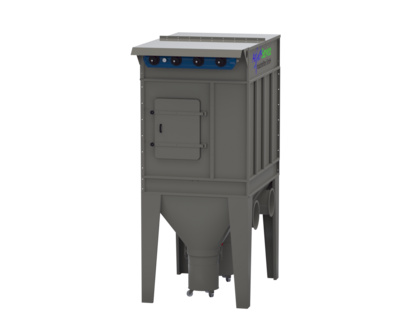
A dust filter serves to clean dust-laden air from the production process and to separate particles in a controlled manner. In the food industry, dust extraction helps reduce air pollution, limit deposits, and promote clean working environments. Effective dust extraction is particularly important in areas with open product movement.
Dust filters can be installed directly on individual machines or as a central filtration system for multiple emission points. A decentralized solution is suitable, for example, for individual bag filling stations, small mixers, or local filling areas. Centralized systems are advantageous when several process steps need to be connected via a shared extraction system.
In food processing applications, meticulous design is crucial. Smooth internal surfaces, easily accessible components, suitable materials, and simple cleaning can be decisive. Depending on the product area, stainless steel components, food-grade seals, or special surface finishes may be required. Dust removal must also be appropriate for the process. Separated dust can be collected in containers, drums, airlocks, or discharge systems. In some cases, it can be recirculated back into the process; in others, the dust must be disposed of separately.
A well-designed dust filter not only improves air quality but can also help reduce product losses, shorten cleaning times, and protect sensitive equipment from dust deposits. Proper sizing is essential to ensure that airflow, filter area, separation efficiency, and cleaning performance are all in harmony.
Bag filters for bulk materials, powders, and high dust loads
A bag filter is a proven solution when food production involves larger air volumes or higher dust loads. It works with filter bags whose surface separates particles from the airflow. Automatic cleaning regularly removes adhering dust from the bags, ensuring consistent filter performance over extended operating periods.
In the food industry, bag filters are frequently used in pneumatic conveying systems, silo filling systems, mixing lines, mills, drying processes, classifiers, dosing stations, and bagging systems. They are particularly suitable for continuous processes that generate a constant stream of dusty air.
The advantage of a bag filter lies in its high degree of adaptability. Filter area, housing size, filter medium, cleaning process, and discharge can all be tailored to the specific process. Special filter materials can be used for food dust, specifically designed to match the particle properties. High separation efficiency is required for fine powders. For sticky or moisture-sensitive products, the filter cleaning process must be designed with particular care. Robust designs are advantageous for abrasive components, such as those found in certain spices or mineral additives.
The airflow within the filter is also crucial. It influences how evenly the filter bags are loaded and how efficiently the captured particles can be discharged. A well-designed construction prevents unnecessary dust accumulation and facilitates maintenance and cleaning.
ATEX Filters for Combustible Food Dusts
Many food dusts are of organic origin and can be flammable under certain conditions. These include, for example, flour dust, sugar dust, starch, cocoa, coffee, milk powder, spice dust, grain dust, and powdered mixtures. If such dusts are finely dispersed in the air and a suitable ignition source is present, an explosive dust-air mixture can form. Therefore, explosion protection is a central issue in many areas of the food industry.
An ATEX filter is used when the risk assessment indicates that explosive atmospheres may occur. This involves more than just the filter housing itself. The entire system must be considered: the capture point, piping, filter unit, fan, dust discharge, control system, and any decoupling devices. Only when all components are coordinated can a coherent safety concept be achieved.
Depending on the type of dust, dust concentration, system design, and installation location, various protective measures may be necessary. These include, for example, pressure relief, flameless pressure relief, explosion isolation, grounding, antistatic filter media, suitable airlock systems, or design measures to prevent ignition sources. The most suitable solution in each individual case must be assessed on a project-specific basis.
Especially in the food industry, ATEX protection cannot be considered in isolation. The system must simultaneously be hygienic, easy to clean, and reliable in operation. An ATEX filter must therefore meet both explosion protection requirements and the practical requirements of production.
Extraction directly at the dust source
A filtration system operates most efficiently when dust is captured at its source. In the food industry, this is often at transfer points, open filling stations, emptying stations, conveyor transitions, mixing tanks, sieves, or packaging areas. By capturing the dust cloud early, less material enters the room, and the required air volume can be used more effectively.
Capture can be achieved via extraction hoods, enclosures, connection ports, extraction tables, source extraction systems, or integrated machine connections. It is crucial that the capture process does not disrupt operations. Employees must be able to open bags, change containers, add ingredients, or clean machines without the extraction system being obstructed. At the same time, the airflow must be powerful enough to reliably capture the particles.
Therefore, sound planning considers not only technical specifications but also the realities of daily operations. Cleaning routes, product changes, maintenance access, ergonomic requirements, and hygiene concepts should be incorporated into the design from the outset.
Filtration Technology for Quality, Hygiene, and Plant Availability
Dust in food production is more than just an air quality issue. Deposits can increase cleaning efforts, promote cross-contamination, impair sensors, or contaminate packaging areas. A suitable filtration system helps keep production areas cleaner and processes more controlled.
For food processing companies, this means greater stability in daily operations. Less dust in the environment can reduce cleaning intervals, improve visibility in the work area, and protect machine components. Product losses can also be reduced by capturing and separating dust-like raw materials in a controlled manner.
Economic design is crucial. An undersized system will not reliably capture dust. An oversized system will result in unnecessary energy and operating costs. Therefore, airflow, filter area, piping, cleaning, fan performance, and safety requirements should be precisely coordinated.
Individual Solutions for the Food Industry
Every food processing plant has different air purification requirements. A large bakery handles different types of dust than a spice mill, a milk powder manufacturer, a confectionery plant, or a grain processing facility. Therefore, dust filters, bag filters, and ATEX filters should always be planned with the specific process in mind.
A reliable solution begins with an analysis of potential air pollutants. What products are processed? Where is the dust generated? What quantities are produced? Is the dust flammable? Does the system need to be particularly easy to clean? Are there frequent product changes? Only with this information can a filter concept be developed that is technically, hygienically, and economically sound.
In the food industry, professional filter technology provides the foundation for clean air, controlled dust separation, and safe production processes. Whether dealing with flour, sugar, starch, cocoa, spices, milk powder, or other powdered raw materials: With suitable dust filters, high-performance bag filters, and ATEX filters designed to meet specific requirements, air pollutants can be effectively reduced and production environments sustainably improved.