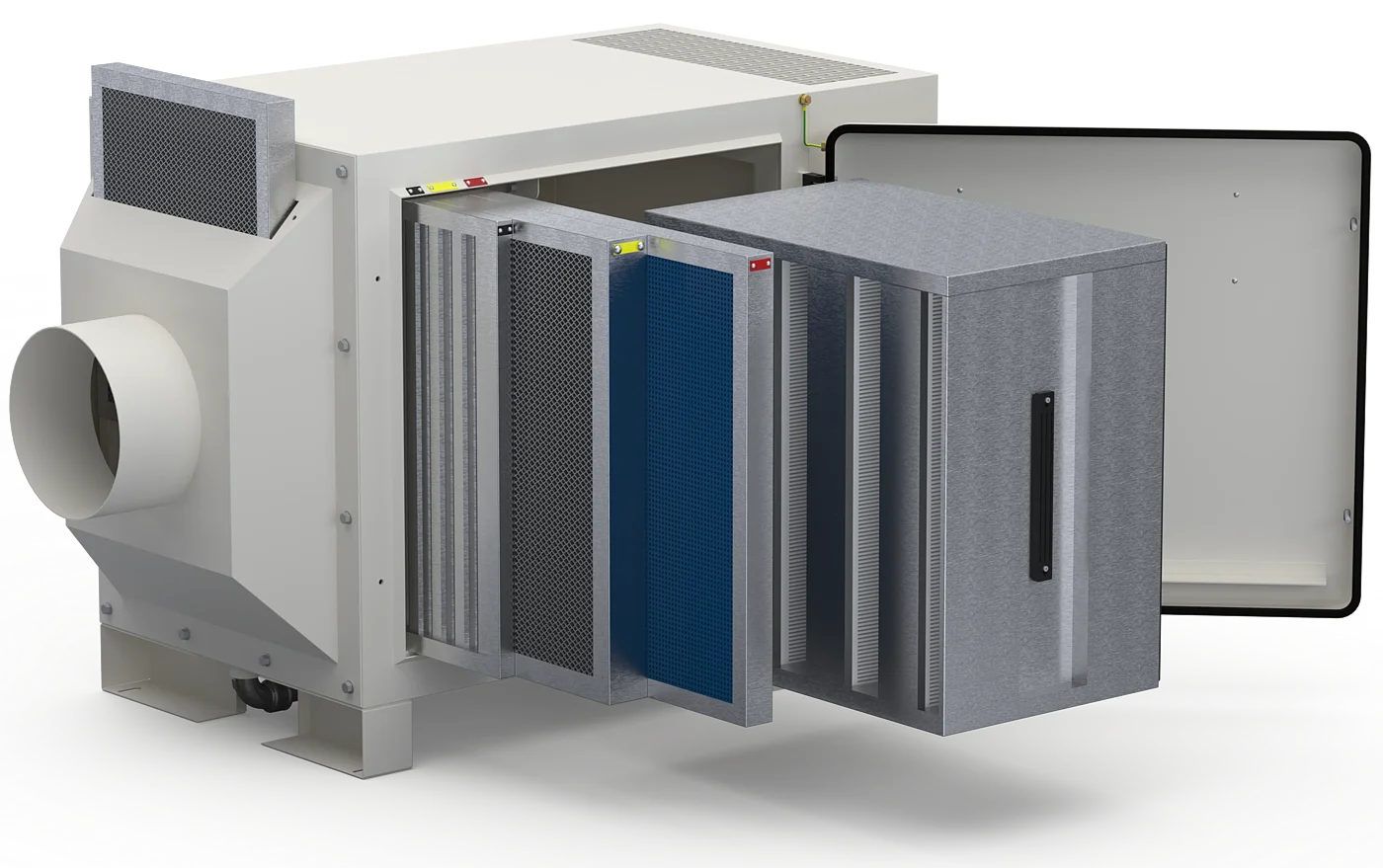
How a Mechanical Filtration System Works
A mechanical emulsion mist filter is a filtration system designed to separate fine liquid droplets from the air. It is primarily used in metalworking applications where metalworking fluid emulsions are used during turning, milling, grinding, or drilling processes. These processes generate what is known as emulsion mist, consisting of finely dispersed droplets of water, oil, additives, and other components of the metalworking fluid.
Unlike an electrostatic filter, a mechanical emulsion mist filter operates without electrically charging the particles. Separation is achieved entirely through physical effects such as inertia, airflow deflection, impaction, coalescence, and filtration.
Basic Principle of a Mechanical Emulsion Mist Filter
The operating principle of a mechanical filtration system can be divided into three simplified steps:
- Extraction of the contaminated air
- Separation of the emulsion droplets inside the filter
- Discharge of the cleaned air and return of the separated liquid
1. Extraction of Air Contaminated with Emulsion Mist
During metalworking, metalworking fluid is applied to the tool and workpiece. High rotational speeds, heat generation, and air movement cause part of the emulsion to become finely atomised. This creates a visible or invisible mist.
The emulsion mist is extracted as close as possible to its point of origin, for example:
- at the machine tool,
- inside the machine enclosure,
- through a capture hood,
- through ductwork or extraction channels.
A fan generates the necessary negative pressure to draw the contaminated air into the mechanical emulsion mist filter.
2. Pre-Separation Through Airflow Deflection and Impaction
In the first section of the filter, the airflow is often deliberately redirected. Due to their mass, larger emulsion droplets cannot fully follow this sudden change in direction.
They strike separator surfaces, louvres, metal mesh, or impact plates and adhere to them. This process is known as impaction separation or inertial separation.
This stage primarily separates larger droplets. The collected liquid then drains downwards.
3. Coalescence: Small Droplets Combine to Form Larger Drops
The most important process within a mechanical emulsion mist filter is known as coalescence.
Fine emulsion droplets come into contact with fibres, wire mesh, or special filter mats within the filter medium. They adhere to the surface. Over time, many small droplets combine to form larger drops.
The process takes place as follows:
- Small droplets collect on the filter medium.
- Additional droplets strike the same area.
- The droplets combine.
- Larger liquid drops are formed.
- These drops become heavy enough to drain downwards.
As a result, the emulsion is not permanently retained within the filter. Instead, it can be separated from the filter in a controlled manner and collected.
4. Fine Filtration of the Remaining Aerosols
Following pre-separation and coalescence, the air passes through additional filter stages, depending on the system design. These stages may consist of different materials, including:
- glass-fibre filters,
- synthetic filter mats,
- metal mesh,
- bag filters,
- compact filters,
- HEPA filters as a final filtration stage.
These filtration stages remove smaller aerosols, fine particles, and residual mist from the air. The finer the filter medium, the higher the separation efficiency. However, a finer filter medium also increases airflow resistance and therefore the pressure drop.
5. Air Recirculation or Exhaust-Air Discharge
Following filtration, the cleaned air can either:
- be returned to the working area or
- be discharged outdoors through an exhaust-air duct.
Whether recirculation is permitted depends on the quality of the filtration, the metalworking fluids used, statutory requirements, and the risk assessment.
6. Discharge of the Separated Emulsion
A major advantage of mechanical emulsion mist filters is that the separated liquid can be collected and discharged. The droplets drain downwards inside the filter housing and are removed through a drain outlet.
Depending on the system, the separated emulsion can be:
- collected,
- disposed of,
- treated or
- returned to the metalworking fluid circuit.
This reduces fluid losses and improves the cost-effectiveness of the system.
Important Separation Mechanisms / How a Mechanical Filtration System Works
A mechanical emulsion mist filter uses several physical effects simultaneously:
Inertial separation: Larger droplets cannot follow changes in the direction of the airflow and strike separator surfaces.
Interception: Small droplets follow the airflow but come into contact with filter fibres and adhere to them.
Diffusion: Very small particles move irregularly and therefore come into contact with filter fibres.
Coalescence: Many small droplets combine to form larger drops and drain from the filter medium.
Gravity separation: Larger droplets move downwards under their own weight.
Advantages of Mechanical Emulsion Mist Filters
Mechanical emulsion mist filters are widely used in industrial operations because they are robust and reliable.
The most important advantages include:
- no high voltage required,
- simple and proven technology,
- effective separation of emulsion mist and metalworking fluid aerosols,
- recovery of separated liquids is possible,
- suitable for many machine tools,
- comparatively straightforward maintenance,
- no electrical charging of the particles required.
Maintenance and Operation
To ensure that a mechanical emulsion mist filter continues to operate reliably over the long term, it must be inspected regularly. Particularly important tasks include:
- cleaning or replacing the filter elements,
- monitoring the differential pressure,
- checking the liquid drain,
- cleaning the housing,
- checking the fan,
- inspecting the seals and ductwork.
An increasing differential pressure generally indicates that the filter elements are contaminated. This reduces the airflow capacity and may make the extraction system less effective.
Difference from an Electrostatic Filter
A mechanical emulsion mist filter operates using filter media and airflow effects. An electrostatic filter, by contrast, electrically charges particles and attracts them to collector plates.
Mechanical Filter:
- operates without high voltage,
- uses filter media,
- is robust in a wide range of applications,
- requires regular filter replacement or cleaning.
Electrostatic Filter:
- operates with high voltage,
- often has a lower pressure drop,
- requires regular cleaning,
- is more sensitive to certain types of contamination and moisture.
Conclusion
A mechanical emulsion mist filter cleans contaminated air by separating emulsion droplets from the airflow. This is achieved through airflow deflection, impaction, coalescence, and fine filtration. The small droplets contained in the metalworking fluid mist collect within the filter medium, combine to form larger drops, and then drain from the filter.
The filter therefore ensures clean air around machine tools, protects employees from exposure to emulsion mist, and contributes to a safe, clean, and cost-effective production environment