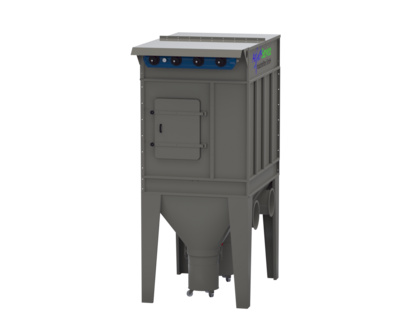
Filter systems for the pharmaceutical industry: Controlled air quality for sensitive production areas
The pharmaceutical industry is among the most sensitive sectors of industrial production. Active pharmaceutical ingredients, excipients, powders, granules, tablets, capsules, liquids, and sterile products are processed here under stringent requirements. Even minor contamination can affect processes, compromise products, or create hazardous work environments. Therefore, controlled airflow plays a crucial role. Modern filter systems help to capture and reduce potential airborne contaminants and provide targeted protection for production environments.
In pharmaceutical facilities, it's not simply a matter of removing dust from the air. Rather, various requirements must be integrated: product protection, employee protection, plant hygiene, process safety, containment, cleanability, and controlled airflow. Depending on the application, filter systems can be installed directly on machines, in closed process plants, in extraction systems, in cleanrooms, or as part of complex air handling systems.
The appropriate solution always depends on the specific pharmaceutical process. A tablet press has different requirements than a capsule filling line, a granulation plant, an active ingredient weighing line, a coating process, or a laboratory area. Therefore, a precise analysis of potential airborne contaminants is the foundation for any effective filtration concept.
Potential Airborne Contaminants in the Pharmaceutical Industry
Many different types of airborne contaminants can arise in pharmaceutical manufacturing. Fine powders and particles released during weighing, dosing, mixing, sieving, granulating, drying, pressing, or filling are particularly common. These include active ingredient particles, excipient dust, granule abrasion, tablet dust, capsule residues, and fine particles from coating processes.
Even small quantities of airborne particles can be significant when processing highly potent active ingredients. Such substances often require special containment solutions to prevent them from entering the work area. The challenge lies in ensuring safe process control without compromising product quality, operability, or cleaning procedures.
In addition to dry particles, aerosols, mists, and vaporous components can also occur in the pharmaceutical industry. This can be relevant, for example, in liquid processes, spray drying, coating, cleaning, disinfection, or certain laboratory applications. Depending on the process, filter systems must therefore be designed not only for particle separation but also for airflow, pre-separation, fine filtration, or special filter stages.
Another potential source of air contamination is product changeovers. When different formulations, active ingredients, or dosage forms are processed on the same equipment, it is essential to prevent the carryover of residues. Suitable filter systems can help limit particle loads and support cleaning processes.
Why filter systems are particularly demanding in pharmaceutical processes
In many industries, dust removal is the primary focus of filter systems. In the pharmaceutical industry, the task is more complex. Here, a filter system often has to fulfill several functions simultaneously. It should reduce the burden on the ambient air, protect the product, shield operating personnel from exposure, and enable a controlled production environment.
The direction of the airflow plays a crucial role. In some areas, the goal is to prevent particles from escaping the process. In others, the product must be protected from environmental contamination. For particularly sensitive applications, graduated pressure concepts, closed systems, or filter stages with defined filtration efficiencies may be required.
Cleanability is also a decisive factor. Pharmaceutical filter systems must be designed to allow for safe and controlled maintenance, filter changes, and cleaning. Smooth surfaces, easily accessible components, suitable seals, and hygienic designs are particularly important. In certain applications, safe-change systems or low-contamination filter change concepts may be advantageous.
Filter Systems for Powders, Granules, and Active Pharmaceutical Ingredients
When processing powders and granules, particles are often generated precisely where material is being moved. Typical emission points include bag handling, big bag emptying, scales, mixers, screening machines, dryers, conveyor systems, tablet presses, and filling stations. Filter systems can be installed directly at these points in the process to capture the contaminated air.
For larger particles, pre-separators or suitable capture elements can be used. For finer dusts, high-performance filter media are required that reliably retain even small particles. Depending on the application, multi-stage systems combining pre-filters, main filters, and fine filters can be advantageous.
Especially with pharmaceutical active ingredients, the design of the filter technology is closely linked to substance evaluation. Dust quantity, particle size, active ingredient potency, occupational exposure limits, cleaning requirements, and process duration all influence the system selection. A filter system for a less critical excipient can be significantly simpler than a solution for highly active or sensitizing substances.
Containment and Employee Protection
A key issue in the pharmaceutical industry is protecting employees from unwanted exposure. If active ingredients or fine powders become airborne, they can be inhaled or settle on surfaces. Therefore, closed or semi-closed filter systems are used in many areas.
Containment solutions can vary considerably. Options include extraction hoods, closed enclosures, isolators, downflow systems, weighing booths, extraction modules, or directly integrated machine filters. Crucially, the airflow must be controlled to prevent particles from entering the work area unimpeded.
Caution is also required during maintenance and filter changes. The filter contains trapped substances and can therefore itself be a source of contamination. Special replacement systems, low-dust disposal concepts, and suitable filter housings can help make handling contaminated filter elements safer.
Product Protection and Prevention of Cross-Contamination
In addition to employee protection, product protection plays an equally important role. In pharmaceutical production areas, foreign particles, residues from other products, or uncontrolled contaminants must not enter sensitive process steps. Filter systems therefore also support the separation of different production areas and process zones.
Especially with frequent product changes, avoiding cross-contamination is crucial. Particles that remain in the ambient air or settle in equipment areas can become problematic in later batches. A well-designed filter and extraction system reduces such risks by capturing particles directly at their source and separating them in a controlled manner.
Filter technology can also be beneficial in packaging areas. Tablet dust, capsule abrasion, or fine powder residues can contaminate machines, sensors, and packaging materials. Targeted air extraction improves cleanliness and supports a stable packaging process.
Filter systems for cleanrooms and controlled areas
Many pharmaceutical applications utilize cleanrooms or controlled production areas. Air quality is particularly important there because particle contamination must be strictly monitored and minimized. Filter systems are an integral part of a comprehensive air handling concept that integrates supply air, exhaust air, recirculated air, pressure maintenance, and air exchange.
HEPA filters, fine filters, and multi-stage filter units can be used to remove particles from the air. Simultaneously, the air must be directed in a way that protects sensitive areas. Depending on the process, a low-turbulence displacement flow, directed airflow, or targeted extraction at specific emission points may be required.
Filter technology should not be considered in isolation. Room layout, machine arrangement, personnel movements, material flow, airlock concepts, and cleaning procedures all influence the effectiveness of the entire system. A filter system is only truly efficient when integrated into the overall pharmaceutical concept.
Maintenance, Monitoring, and Operational Reliability
To ensure the long-term reliability of filter systems, they must be monitored and regularly maintained. This is particularly important in the pharmaceutical industry because declining filter performance can impact air quality, product protection, and process safety. Differential pressure monitoring, filter condition monitoring, documented maintenance intervals, and clearly defined replacement processes ensure stable operation.
The selection of filter elements also influences operational reliability. Filter media must be suitable for the particle type, air volume, humidity, temperature, and the specific process. Incorrect selection can lead to rapid filter loading, high pressure drop, insufficient separation, or difficult filter replacement.
Modern filter systems can be integrated into plant control systems. This allows for monitoring of operating conditions, issuing of warning messages, and improved maintenance planning. This transparency is particularly valuable for pharmaceutical companies, as production processes often need to be documented and traceable.
Customized filter solutions for the pharmaceutical industry
The requirements for filter systems in the pharmaceutical industry are as diverse as the products themselves. A manufacturer of solid dosage forms needs different solutions than a sterile liquids plant, an active pharmaceutical ingredient (API) producer, a laboratory, a pilot plant, or a packaging center. Therefore, filter systems should always be designed with the specific application in mind.
The process begins with an assessment of potential air contaminants. What substances can be released? Are they APIs, excipients, granules, aerosols, or cleaning residues? How critical are these substances for employees and the product? Where do the emissions originate? How frequently do product changes occur? What are the requirements for cleaning, maintenance, and documentation?
Based on this information, a filter system is developed that not only functions technically but also integrates seamlessly into daily pharmaceutical operations. It supports clean production conditions, reduces particle contamination, improves airflow control, and contributes to making sensitive processes safer.
Pharmaceutical Industry: Safely Controlling Air Contaminants
For the pharmaceutical industry, professional filter technology is therefore much more than just an auxiliary component. It is a key component for controlled manufacturing, the protection of sensitive products, and safe working environments. With individually designed filter systems, potential air pollutants can be specifically detected and reliably reduced – from raw material handling and active ingredient processing to the packaging of finished pharmaceutical dosage forms.