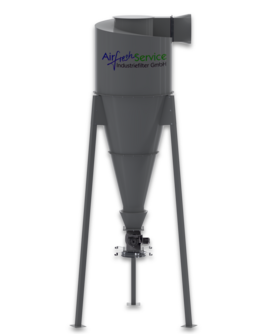
Cyclone separators and cyclone filters for industry
Cyclone separators & cyclone filters - preseparators for industry are a proven and high-performance solution for the mechanical separation of dust, chips, granules, and other solid particles from air or gas streams. This technology is used in industry wherever large quantities of particles need to be reliably removed from a process stream. Whether in woodworking, metalworking, plastics processing, food production, chemicals, recycling, or general process engineering – industrial cyclone separators make a significant contribution to clean production processes, increased operational reliability, and efficient material recovery.
The major advantage of a cyclone filter lies in its simple, robust, and low-maintenance operation. Unlike many other filter systems, a cyclone separator operates without conventional filter media. Separation occurs through centrifugal force: The contaminated airflow is introduced tangentially into the cylindrical or conical housing and set into rotation. This rotation forces heavier particles outward against the housing wall, causing them to lose speed and fall into a collection container or discharge chute. The purified air exits the cyclone through the central outlet. This principle makes the cyclone separator particularly durable and ideal for continuous industrial operation.
Industrial Cyclone Separators for Dust, Chips, and Particles
In many industrial plants, large quantities of dust, fibers, chips, or granulate residues are generated during production. These particles can put a strain on machinery, impair production quality, or lead to increased cleaning efforts. A professionally designed industrial cyclone separator ensures that these particles are removed from the airflow at an early stage. This reduces the load on downstream filter systems, extends maintenance intervals, and lowers operating costs.
Cyclone filters are particularly often used as pre-separators. In this function, they remove coarse and medium-sized particles before they reach the actual fine filter. This protects filter cartridges, bag filters, or other downstream systems from rapid clogging. At the same time, a cyclone separator can also be used as a standalone separation solution if the requirements for separation efficiency and particle size permit. The specific design depends on factors such as airflow rate, particle size, particle density, temperature, humidity, material properties, and process conditions.
How a Cyclone Filter Works
The function of a cyclone filter is based on a clear physical principle. Contaminated air or a particle-laden gas stream enters the separator laterally. The tangential inflow creates a spiral flow that moves downwards along the inner wall. The particles contained in the airstream are forced outwards by the resulting centrifugal forces. There, they lose speed and are carried by gravity towards the discharge outlet.
The cleaned air then moves upwards again inside the cyclone and exits the separator through the clean gas outlet. In this way, the cyclone separator efficiently separates particles from the airstream without the need for regular filter element replacement. This makes this technology particularly attractive for industrial applications with high particle loads, abrasive media, or large air volumes.
Advantages of Cyclone Separators in Industrial Applications
A high-quality industrial cyclone separator offers numerous advantages. One of the most significant benefits is its robustness. Because no sensitive filter media are used in the main separation process, the system is less susceptible to wear and tear due to clogging. Cyclone filters are particularly effective when dealing with coarse particles, chips, fibers, or granules.
Another advantage is the low maintenance requirement. While conventional filter systems require regular cleaning or replacement of filter elements, the maintenance of a cyclone separator is often limited to checking the discharge, ensuring the system is leak-tight, and performing general condition checks. This reduces downtime and lowers operating costs.
Using a cyclone separator can also be beneficial from an energy perspective. By relieving the load on downstream filter systems, the pressure drop in the overall system remains more manageable. This can positively impact the efficiency of fans and extraction systems. Furthermore, reliable pre-separation enables more stable process control, which is particularly important in automated production lines.
Applications of Cyclone Separators and Cyclone Filters
Cyclone separators are used in many industries. In the woodworking industry, they are used to separate wood chips, sawdust, and grinding dust. In metal processing, they can remove metal shavings, grinding particles, or dry process residues from exhaust air. In the plastics industry, cyclone filters are used for conveying and separating granules, plastic dust, or ground material.
Cyclone separators are also used in the food industry, for example, to separate powders, flour, starch, sugar, or other dry bulk materials. In the chemical industry and process engineering, they support the separation of solids from process gases. In the recycling and waste management sector, cyclones help separate dust, fibers, and light particles from transport or exhaust air streams.
Depending on the industry and application, cyclone separators can be manufactured from various materials. Steel, stainless steel, or wear-resistant special designs are frequently used. For hygienic applications, smooth surfaces, suitable seals, and easy-to-clean designs are particularly important. Additional wear protection measures may be advisable for abrasive media.
Cyclone separators as part of modern dust collection systems
A cyclone filter is often a component of a comprehensive industrial dust collection system. It can be installed upstream of filter systems, fans, silos, pneumatic conveying systems, or exhaust air systems. Due to its position in the process, it can recover valuable material, protect downstream components, and improve the overall efficiency of the system.
The combination of a cyclone separator and a fine filter is particularly effective when dealing with high dust loads. The cyclone handles the coarse separation, while the downstream filter removes the remaining fine dust particles. This extends the service life of the filter elements and increases operational reliability. For companies, this translates to less maintenance, lower spare parts costs, and reliable adherence to the desired air quality.
Custom Design for Maximum Separation Performance
Proper design is crucial for a cyclone separator to achieve its full potential. An undersized cyclone can lead to high pressure drop and insufficient separation. An oversized separator may not reach the necessary flow velocity to efficiently separate particles. Therefore, air volume, particle distribution, material density, temperature, humidity, and system layout should be carefully considered.
Modern industrial cyclone separators can be adapted to specific requirements. This includes various sizes, connection options, discharge systems, collection containers, rotary valves, pressure relief devices, special materials, and wear-resistant inner linings. Mobile or compact versions are also available if the cyclone filter needs to be used flexibly on different machines or systems.
Why a cyclone separator is an economical solution
For industrial companies, not only technical performance but also cost-effectiveness is crucial. A cyclone separator offers a long service life, low maintenance costs, and versatile applications. Since no conventional filter media are required for the primary separation process, the need for consumables is reduced. At the same time, other filter components are protected, which can lower the overall cost of the dust collection system.
Another economic advantage arises from material recovery. In many production processes, separated particles, powders, or granules can be reused or disposed of in a controlled manner. This improves resource efficiency and supports sustainable production processes. Especially in industries with high material costs, a high-performance cyclone filter can therefore quickly pay for itself.
Conclusion: Cyclone Filters for Efficient Industrial Air and Material Separation
An industrial cyclone separator is a robust, efficient, and economical solution for separating dust, chips, granules, and solid particles from air and gas streams. Its low-maintenance design, reliable operation, and versatile application possibilities make the cyclone filter suitable for numerous industrial applications. Whether as a pre-separator, part of a dust collection system, or a standalone particle separation solution, a professionally designed cyclone separator contributes to cleaner processes, increased system availability, and reduced operating costs.
Anyone looking to clean industrial exhaust air, protect machinery, reduce the load on filter systems, or efficiently recover materials will find a high-quality cyclone separator a future-proof investment. With appropriate sizing and application-specific design, the cyclone filter can be optimally integrated into existing or new production facilities and operated economically in the long term.